
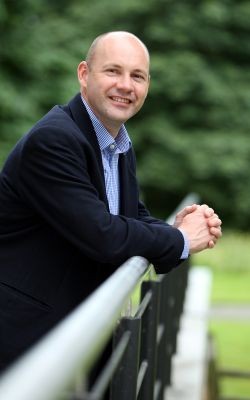
Interim Pro-Vice-Chancellor (Research & Innovation): Professor Mark Brandon
Role
Professor Mark Brandon is the Interim Pro-Vice-Chancellor for Research and Innovation with senior responsibility for strategic leadership and implementation of the institutional plans for research, knowledge exchange and scholarship.
The Research, Enterprise & Scholarship (RES) Unit facilitates the University's excellence in research, enterprise, scholarship and external engagement as well as to provide expert strategic and support services across these activities.
It works in support of Faculties, Schools and Institutes, as well as with a wide range of external partners, collaborators and funders.
It is responsible for the University’s submissions to the UK-wide Research Excellence Framework (REF) and our institutional approach to knowledge exchange and expansion of entrepreneurial activities.
Background
After completing a doctorate at the Scott Polar Research Institute (Cambridge University) and spending 5 years in the British Antarctic Survey, where he also worked as an Open University Associate Lecturer, Mark joined The OU as a Lecturer in Environmental Science in 2000. Based in the School of Environment Earth and Ecosystems (STEM Faculty) he has built a research career on Arctic and Antarctic science and was promoted to Professor of Polar Oceanography in 2017. Through his career he has spent over three years in the Arctic and Antarctic on remote field work and is an expert on how the heat from the ocean is melting the edges of the great ice sheets.
Mark has always been interested in the impact of research and has worked extensively with the BBC as an academic advisor on landmark television series including Frozen Planet, Frozen Planet II and Blue Planet II. The use of his research in these broadcast projects led him to write two highly regarded Research Excellence Framework impact cases for the 2014 and 2021 cycles.
Within the community, Mark was the Co-Chair of the UK expert group on Ice Sheet Stability (iSTAR) and helped define a major research program on the area of Antarctica that is most rapidly melting. Subsequently, he chaired the Steering Group for a major Antarctic oceanographic program focussed on the Role of the Southern Ocean in the Earth System (RoSES). He has worked for the Canadian Environmental Research Council (NSREC) and The Research Council of Norway over many years as a polar expert and is currently a standing chair for the UK Natural Environment Research Council, chairing numerous grant panels. Most recently Mark has been a Special Advisor to the Environment Audit Committee in the Houses of Parliament for their inquiry into the UK and the Antarctic. In 2021 he was award an MBE for "services to polar science", and 2024 he was awarded the Polar Medal with the citation "Antarctic and Arctic to 2022".
A personal moment with Mark
What excites me about being a member of VCE
I had an unusual childhood and was a free school meals kid in East London. Today, we would say where I grew up scored high on the Index of Multiple Deprivation (IMD – the official measure of relative deprivation in England). Education was the difference that enabled me to do things I could never have imagined, so I've always been attracted to the university that offers no barriers to study for anyone and is four nations. To be able to contribute to the success of an organisation that really does change people's lives is what gets me out of bed in the mornings.
Favourite place in the world
That's an easy one for me, it's Antarctica. There's something otherworldly about that continent and having been there in winter was life-changing. I came back knowing I had to work my hardest to help as many people as possible understand how we're changing the climate of our planet.


Explore

Undergraduate
Postgraduate
Policy
-
Follow us on Social media
-


